Step 4 of 4 · Bankei
Bankei Yotaku and the Unborn Buddha-mind.
Bankei Yotaku (1622–1693) was a Japanese Rinzai Zen master who taught ordinary people to recognize the Unborn Buddha-mind already present in their daily lives.
He nearly died looking for what had never left. His authority did not come from distance or perfection. He knew the violence of spiritual ambition from inside it, and spent the rest of his life telling people they did not need to repeat his mistake.
The question
What is “bright virtue”?
As a child, Bankei heard a phrase from the Confucian Great Learning and demanded to know what it meant in lived experience. Explanations did not satisfy him. That refusal launched a search through monasteries, mountains, study, hunger, and illness.
His breakthrough did not crown the search. It exposed the search as unnecessary.
Why Bankei challenged Rinzai methodsBorn in Harima
Bankei Yotaku was born in Harima Province in western Japan. As a boy, he became consumed by the Confucian phrase “bright virtue” and would not accept an answer he could not verify.
The search begins
He ordained under Umpo Zenjo and then wandered in search of a teacher who could answer him directly. Study, travel, and increasingly severe austerities followed.
At the edge of death
Sick with tuberculosis after years of harsh practice, Bankei coughed against a wall and suddenly understood that every matter was settled in the Unborn. The thing he had nearly died seeking had never been absent.
Recognition, not possession
At Sofuku-ji in Nagasaki, the Chinese master Dosha Chogen recognized the depth of Bankei's realization. Bankei remained wary of turning recognition into rank or authority.
Plain speech
Bankei began teaching publicly in the language of ordinary people rather than the literary Chinese favored by the Zen establishment. Farmers, merchants, samurai, monks, and women heard the same direct message.
Abbot without a system
He served as abbot of Myoshin-ji, one of Rinzai Zen's most important temples, while continuing to criticize mechanical koan study and spiritual credentialism.
No ladder left behind
Bankei died at Ryumon-ji at seventy-one. He left sermons and dialogues, but no proprietary method. The absence of a system was not an oversight; it followed from the teaching itself.
After Bankei
A teaching too alive to be owned.
Later Rinzai Zen was shaped more strongly by Hakuin’s rigorous koan system. Bankei’s teaching remained in sermons, poems, and records: startlingly available, resistant to rank, and difficult to turn into a ladder.
Its fragility is also its integrity. The Unborn cannot be owned by paper, guaranteed by costume, or withheld by a teacher. It can only be pointed out and lived.
This site explores how Bankei’s recorded teaching can apply to ordinary life: do not trade the Unborn Buddha Mind for thoughts. What arises can arise without becoming a self or a position to defend. The Unborn is already present; practice is living from it.
Reading & sources
Go to the records.
Bankei ZenTranslated by Peter Haskel; edited by Yoshito Hakeda. Grove Press, 1984. Start with “Listen carefully,” then “Let it be.”
The UnbornTranslated by Norman Waddell. North Point Press, revised edition, 2000. Includes the Ryumon-ji and Hoshin-ji sermons.
Selected Works of D. T. SuzukiHistorical appreciation and context
Passages labeled “Our paraphrase” restate the teaching in contemporary language. Read the named passage for the translator’s exact wording and full context. Passage titles refer to Haskel’s edition; page references specify Waddell’s revised edition.
At the end of the reading path
A small remembrance.
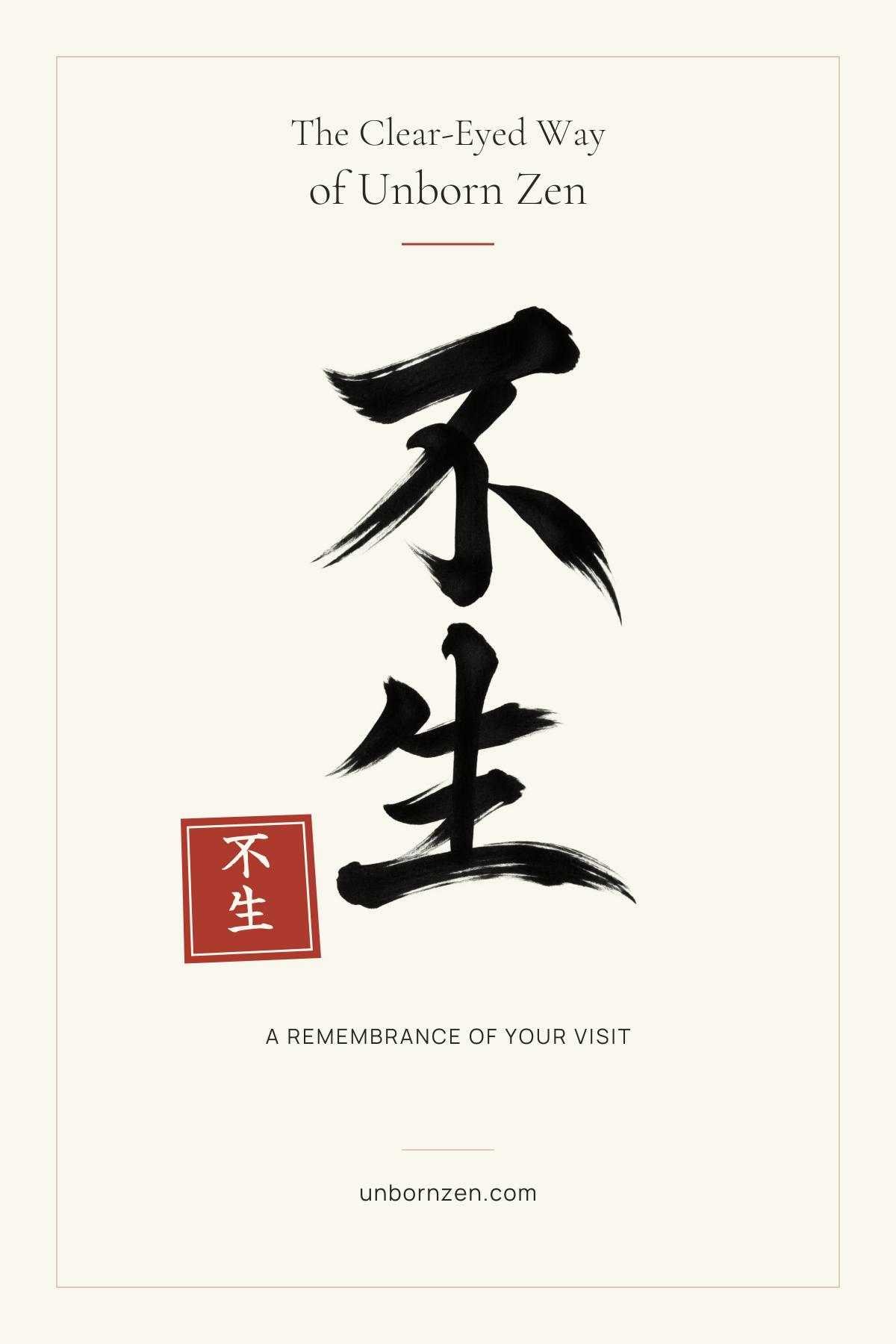
Thank you for spending time with Bankei’s teaching. Take this small remembrance with you.
A goshuin-inspired commemorative seal from the Clear-Eyed Way of Unborn Zen. Your seal receives the date you download it, in your local time. It is a keepsake, not a certificate of completion, qualification, or spiritual attainment.
PNG · 1200 × 1800 pixels
Print at 4 × 6 inches (10 × 15 cm), or keep it on your screen.

Learning path · Step 4 of 4